
Introduction
AWS Lambda is a powerful, fully managed serverless computing service that enables applications to run code automatically in response to events. It eliminates the need to manage servers, as AWS handles infrastructure provisioning, scaling, and availability. This allows businesses to focus on building features while reducing operational complexity and cost.
Event-driven architecture is a design approach where application components are triggered by events such as API requests, database updates, file uploads, or scheduled jobs. AWS Lambda listens for these events and executes the required code instantly, making applications highly responsive, scalable, and efficient.

Why Choose AWS Lambda?
We deliver end-to-end event-driven solutions using AWS Lambda that are secure, scalable, and optimized for performance. Our expertise ensures best-practice architecture, efficient execution, and long-term reliability for your applications.
How AWS Lambda Works
When an event occurs, AWS Lambda automatically allocates the required compute resources and executes the function code. Once the execution is complete, the resources are released. This on-demand execution model removes the need for server management and ensures optimal performance at all times.
Common Use Case
Backend APIs and microservices
AWS Lambda is widely used to build scalable backend APIs and microservices. It can handle API requests automatically, scale based on traffic, and integrate easily with Amazon API Gateway, allowing developers to create reliable and cost-efficient backend systems without managing servers.
Real-Time Data Processing
Lambda can process streaming data in real time from sources such as databases, IoT devices, or event streams. It enables instant data transformation, filtering, and analytics, making it ideal for applications that require quick insights and immediate responses.
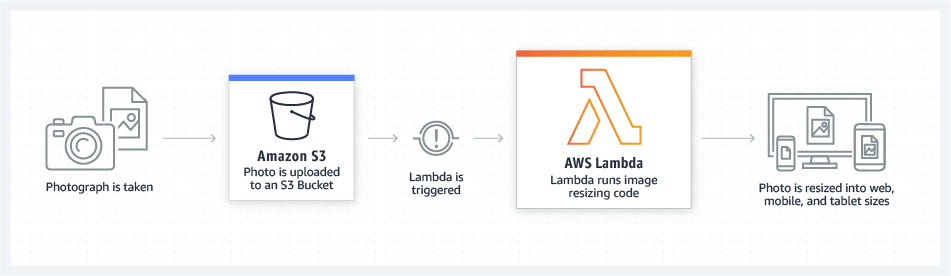
File and Image Processing Workflows
AWS Lambda can automatically process files and images when they are uploaded. Common tasks include resizing images, converting file formats, extracting metadata, and validating files. This makes it perfect for media processing and document management systems.
Automation and Scheduled Tasks
Lambda is commonly used for automation tasks such as backups, system maintenance, data cleanup, and report generation. Using scheduled triggers, it can run tasks at specific times without the need for dedicated servers or cron jobs.
Key Features of AWS Lambda
-
Serverless Computing
No server provisioning or maintenance required
-
Automatic Scaling
Scales automatically based on incoming events
-
High Availability
Built-in fault tolerance and reliability
-
Strong Security
Integrated with AWS security best practices
-
Multi-Language Support
Supports Python, Node.js, Java, Go, and more
Business Benefits
AWS Lambda helps organizations accelerate development, reduce infrastructure costs, and improve application performance. With a pay-as-you-use pricing model, you are charged only for the actual execution time, making it a cost-effective solution for modern cloud applications.